
Exchange News Trading Checklist: A Practical 5‑Point Playbook
A fast, repeatable 5‑point checklist to assess liquidity, tag event trades, and stress-test strategy variants after exchange revenue misses or similar venue shocks.
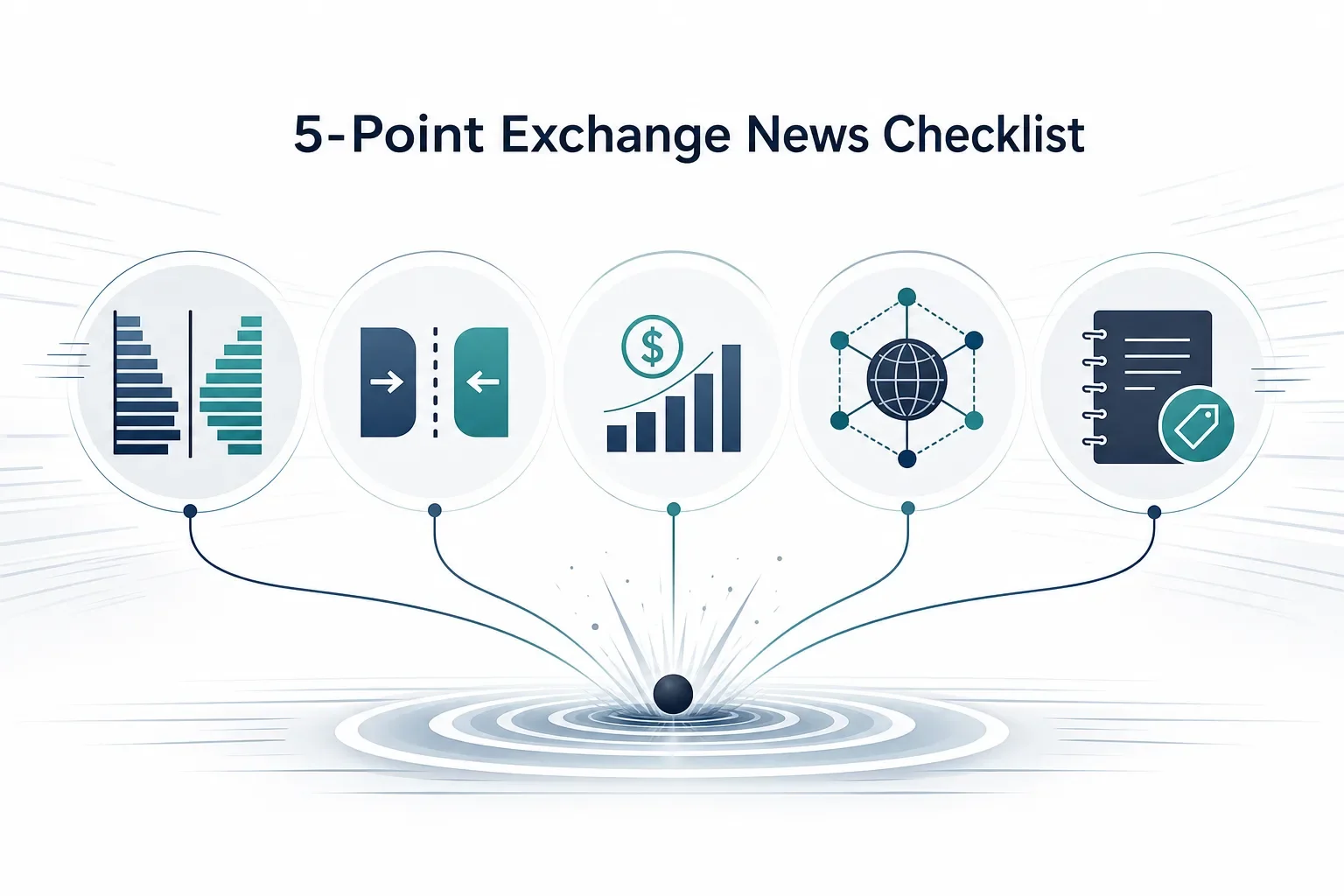
# Exchange News Trading Checklist: A Practical 5‑Point Playbook
Exchange-specific announcements — a revenue miss at a major exchange, a sudden withdrawal freeze, or an unexpected outage — can change liquidity and execution conditions in minutes. This short playbook gives a fast, repeatable five-step checklist to assess market impact, tag event-period trades, and stress-test strategy variants so you can make measured decisions instead of reacting to noise.
## Goal and scope
Goal: Run a rapid assessment (5–15 minutes) to decide whether to pause, hedge, or continue trading a strategy after exchange news.
Scope: spot and derivatives across venues; applicable to discretionary and systematic traders and trading teams.
This guide also shows how to record assumptions, tag trades, and compare variants using Trade Strategy. Create and document strategies with Strategy management, record event trades in the Historical results journal, and evaluate variants with Strategy comparison. If you’re on the Elite plan, AI-powered recommendations can surface candidate parameter changes as decision support — treat those outputs as inputs to validate, not prescriptions.
## The 5‑point checklist (fast actions)
Run these five checks to classify the event as liquidity-driven, sentiment-driven, or a structural regime change.
### 1) Liquidity — market depth and venue availability
Action:
- Check order-book depth on the primary venues for BTC and your traded pairs. Look for reduced displayed depth or order-book holes at your expected execution sizes.
- Verify exchange uptime and any deposit/withdrawal notices on official channels.
Decision-rule examples:
- If a large percentage of your usual execution size is missing from the book, reduce size or pause new entries.
Practical tip: Pull a recent snapshot of order-book depth for a familiar execution bucket and compare it to the live view. Save both screenshots or logs to your results journal for later review.
### 2) Spreads and realized slippage
Action:
- Monitor bid-ask spreads and recent fill slippage for the last 30–60 minutes versus your baseline.
- For market-making or scalping, check the spread bands your algo expects and whether fills are systematically outside them.
Decision-rule examples:
- If spreads are materially wider than baseline or realized slippage exceeds your max tolerable cost, switch to limit-only executions or pause.
Practical tip: Use a short sample of recent fills to compute average slippage. Record that figure in your event notes so you can compare it across future events.
### 3) Open interest and funding (derivatives risk)
Action:
- Check open interest and funding-rate moves on the perpetuals and futures venues you use.
- Watch for rapid OI drops (liquidations) or sudden funding spikes that signal directional stress.
Decision-rule examples:
- If OI moves sharply in either direction in a short period, expect amplified volatility and reduce directional exposure.
Practical tip: Capture a two-hour OI and funding snapshot and save it alongside your execution logs.
### 4) Correlated assets and cross‑market signals
Action:
- Check correlated markets (ETH, major alts, BTC futures vs spot basis, relevant equities or macro proxies) for confirmation or divergence.
- Note whether futures basis or funding behavior diverges from spot — that can indicate execution/roll pressure rather than pure spot-driven conviction.
Decision-rule examples:
- Require confirmation from at least one correlated market before assuming a sustained directional move; otherwise treat the move as potential liquidity noise.
### 5) Stops, position sizing and immediate trade tagging
Action:
- Enforce pre-defined stop and sizing rules for event windows (for example, reduce size or widen stops by a pre-specified factor).
- Tag all fills executed in the event window with an "event" label (include start/end timestamps and the reason).
Decision-rule examples:
- Reduce target leverage or half new position sizes during the event window; record any deviations from normal rules.
Practical tip: Tag trades at execution time and add a brief note explaining the action taken. These tags make later comparison straightforward.
## How to document the event (consistent record format)
Maintain a consistent event record so results are comparable across events and traders. Store this in your results journal or a central spreadsheet and mirror it in Trade Strategy's Historical results journal.
Suggested fields and examples:
| Field | Example / Guidance |
|---|---|
| Event name | Exchange revenue miss — Coinbase (example) |
| Event window | Start and end timestamps (UTC) — mark when market reaction began and when conditions normalized |
| Tagged trades | All fills between timestamps with tag: event/exchange-rev-miss |
| Liquidity notes | Order-book depth reduced for typical buckets; spreads widened |
| Derivatives notes | OI dropped / funding spiked (capture venue and sample) |
| Immediate action | Paused market-making on high-spread pairs; reduced directional sizes |
Store one row per event in your Historical results journal so you can filter and compare later.
## Stress-testing strategy variants after the event
1. Create strategy variants: baseline (no change), conservative (smaller size/wider stops), and paused (no trading during event window). Document the rules in Strategy management.
2. Use execution logs and Historical results journal entries to review performance during the event window and comparable historical events (outages, prior exchange shocks).
3. Compare: drawdown during event windows, realized slippage, trade count, and average trade P/L.
4. Use Strategy comparison to view which variants preserved capital or produced acceptable execution costs.
Practical example:
- Baseline: normal size — drawdown X, avg slippage Y
- Conservative: size halved — drawdown smaller, slippage reduced
- Paused: zero trades during event — avoids event slippage but may miss reversion opportunities
Avoid changing rules based on a single event without corroborating historical examples.
## Using AI-powered recommendations (Elite plan) as decision support
If you’re on Trade Strategy’s Elite plan, AI-powered recommendations can analyze strategy performance, trade history, and current parameters to surface suggested adjustments. Treat these outputs as probabilistic decision support: use them to highlight unusual slippage patterns, candidate parameter changes, or strategy variants to test — then validate against raw execution data before applying live.
Do not treat AI suggestions as guaranteed predictions or personalized financial advice.
## A 10‑minute field checklist
- Check exchange notices and venue uptime (2 minutes)
- Measure current depth and spreads vs baseline (2 minutes)
- Inspect open interest and funding changes (1–2 minutes)
- Tag event trades and add immediate notes to your results journal (2 minutes)
- Decide which variant to apply (1–2 minutes)
## Conclusion
Exchange-specific news often causes execution and liquidity shocks that matter more to short-term strategies than long-term fundamentals. A concise, repeatable checklist — combined with consistent event tagging, documented strategy variants, and focused comparisons — turns ad-hoc reactions into repeatable operational improvements. Use Strategy management to document rules, the Historical results journal to log event trades, and Strategy comparison to evaluate which variants held up. If you have the Elite plan, use AI-powered recommendations as decision support, validate suggested changes against your data, and codify the variant that performed best for future events.
Ready to start documenting and testing event-driven variants? Document the event, tag trades, and compare variants — learn how at https://trade-strategy.com
 2026-08-11
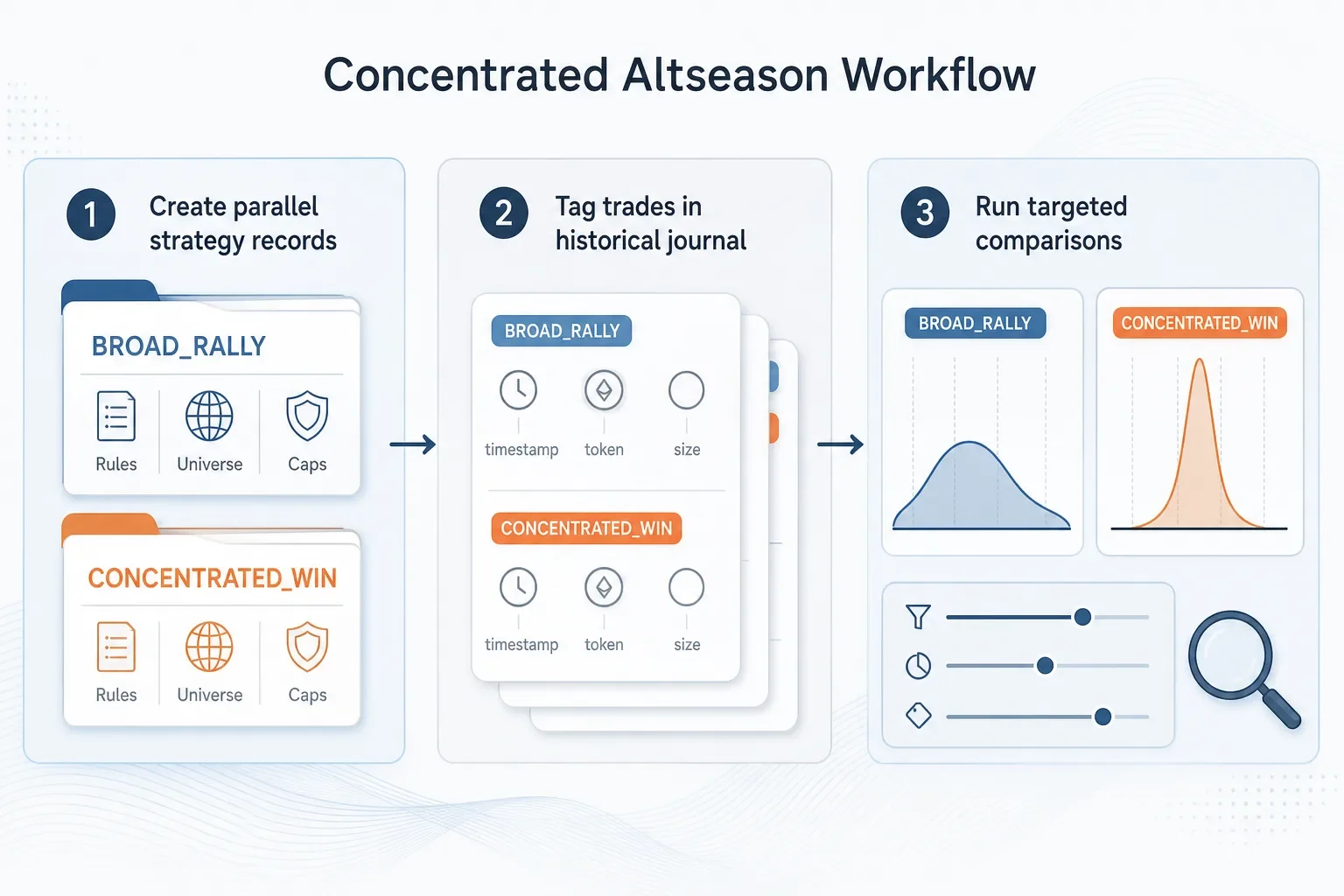
How to Adapt Your Strategies for a More Concentrated Altseason
Step-by-step workflow to adapt trading strategies for a concentrated altseason: create regime-specific strategy records, tag outcomes in a historical journal, compare results across token subsets, and apply concentration-aware sizing and monitoring.
 2026-08-11
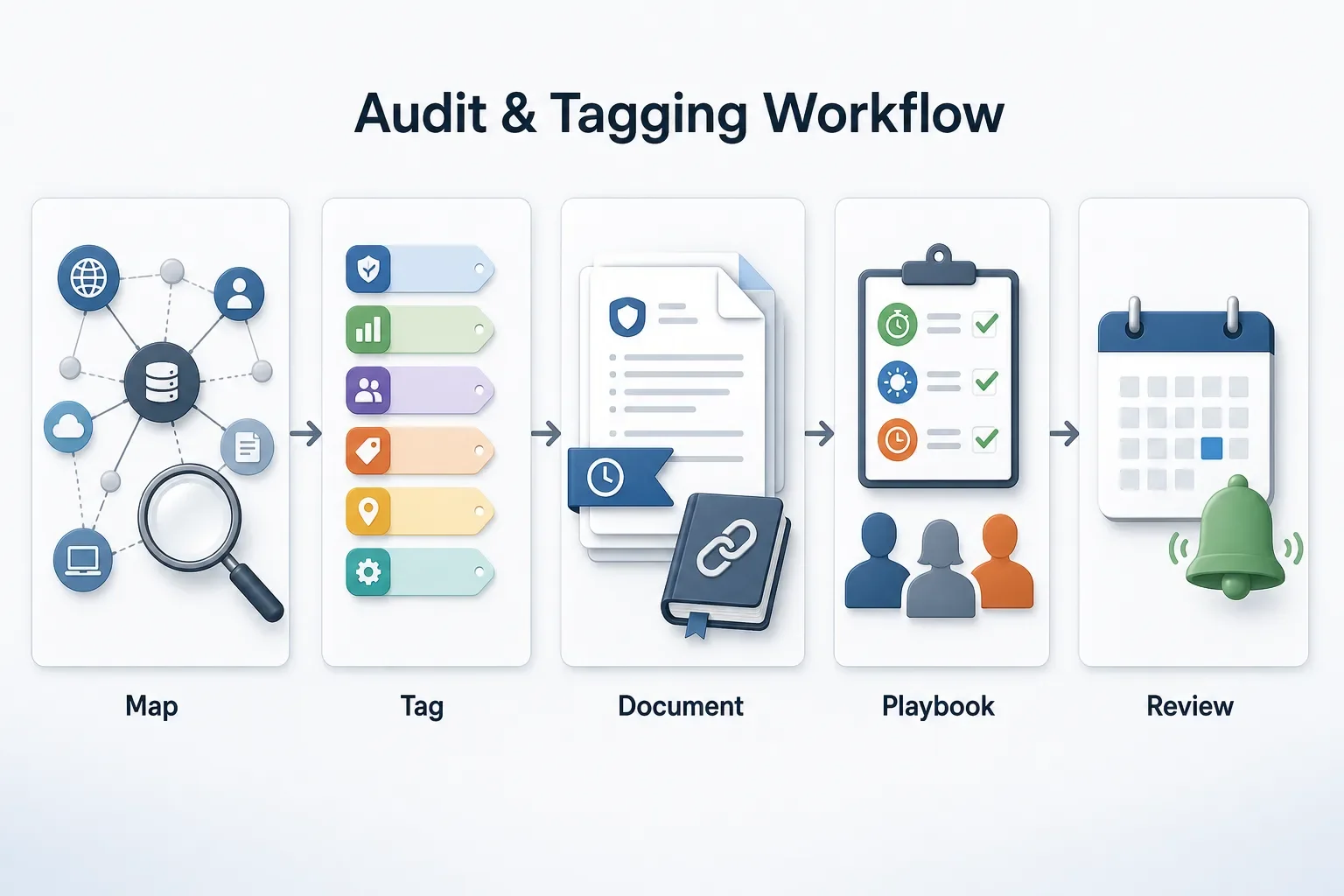
How to Audit and Tag DeFi Strategies for Regulatory Exposure
Practical, step‑by‑step workflow to map DeFi protocol touchpoints, tag regulatory exposure, preserve audit trails with documented rules and historical results, and prepare playbooks to respond quickly to enforcement events.
 2026-08-11
Miner Stress Testing for BTC Strategies: A Reproducible Case Study & Template
A forensic primer on turning a ~14% Bitcoin difficulty drop into testable strategy rules. Learn which miner metrics to track, how to encode stress variants (sizing, stops, filters) and how to record reproducible case studies in Trade Strategy.